Ask a Philippine photo shop for an ID picture and you'll be handed a 2×2. Ask most Filipinos what size a passport photo is and they'll say 2×2. It's the default, it's what every corner studio prints, and for a good number of applications it's the wrong size.
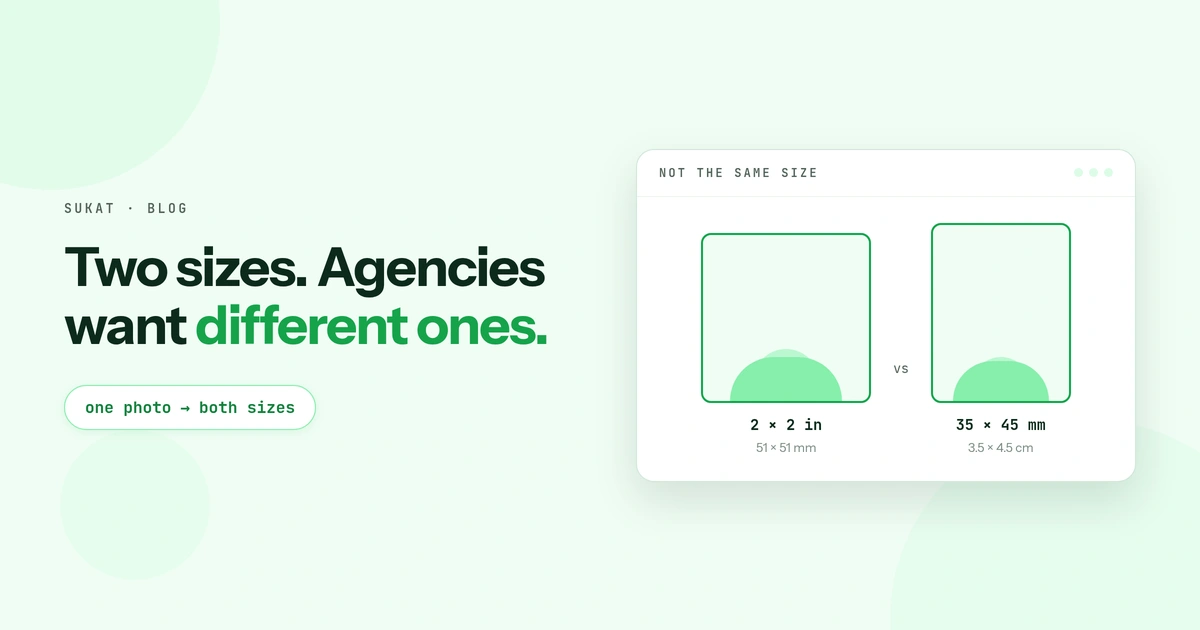
2×2 inches is a square, and it's the United States standard. The Philippine ePassport photo specification is 35 × 45 mm — a portrait rectangle, not a square. They are not interchangeable, and submitting a US-format photo where Philippine specs were asked for is one of the most common reasons an application comes back.
The two sizes, side by side
| 2 × 2 inches | 35 × 45 mm | |
|---|---|---|
| Shape | Square | Portrait rectangle |
| In millimetres | 51 × 51 mm | 35 × 45 mm |
| In inches | 2 × 2 in | 1.38 × 1.77 in |
| Also called | ID picture, US passport size | Passport size, 3.5 × 4.5 cm |
| Origin | United States standard | ICAO / most of the world |
A 35 × 45 mm photo is noticeably narrower and slightly shorter than a 2×2. Cropping one from the other doesn't work by eye — the head sits at a different proportion of the frame in each, so a square photo trimmed down to a rectangle usually ends up with the head too large or the chin too close to the edge.
Which one does each agency want?
Philippine ePassport (DFA). The specification is 35 × 45 mm, with the head measuring roughly 32–36 mm from chin to crown. In practice the DFA captures your biometric photo digitally at your appointment, so you are usually not submitting a printed photo at all — what matters is turning up groomed to the standard rather than bringing a print. Glasses are not permitted, and the background must be plain white.
NBI clearance. Two 2×2 colour photos with a white background, taken recently. Note that this is the square format, not the passport format — one of the clearer cases where the two genuinely differ.
PRC (Professional Regulation Commission). Depends on the board. Some professions ask for passport size at 35 × 45 mm, others for 2×2, so check your board's own checklist rather than assuming. PRC adds two requirements people miss: a collared top and a name tag showing your complete name. For a LERIS online upload the file needs to be a JPG under 2 MB. Sukat has a full PRC photo guide covering this.
SSS and UMID. A 2×2 photo for the application form. As with the passport, the photo printed on the card itself is the biometric one captured at the branch, so bring a print as backup for the paperwork rather than expecting it to end up on the card.
Philippine visa applications. This one varies by post, which catches people out. Some consulates specify 2×2, others specify 35 × 45 mm and reject digital submissions outright. Check the specific embassy or consulate handling your application — there is no single national answer.
Dual citizenship (RA 9225), school IDs, company IDs, job applications. Generally 2×2, but these are the least standardised of the lot. Ask before you print.
The rules that apply to both sizes
Whatever the dimensions, Philippine agencies converge on the same handful of requirements, and most rejections come from these rather than from the size:
- Plain white background. Off-white, beige, cream, and light grey get rejected. A wall that looks white to your eye often photographs slightly warm or slightly blue.
- No glasses. Current DFA guidance does not permit eyeglasses in biometric photos, and other agencies have followed. Coloured contact lenses are out too.
- Neutral expression, both eyebrows visible, ears exposed where specified. No raised eyebrows, no squinting, no contrived expressions.
- Recent. Most agencies want a photo from the last three to six months that reflects how you currently look.
- No headwear except daily religious wear that doesn't obscure the face. Remove large earrings and necklaces.
Making both sizes from one photo
Because different agencies want different formats, the practical approach is to take one good photo and produce both crops from it rather than booking two studio sittings.
The photo itself has to be right at capture — plain background, even lighting, camera at eye level about a metre away, someone else holding it rather than a selfie at arm's length, which distorts the face. No tool fixes a photo taken under a ceiling light with a shadow behind the head.
Once you have it, Sukat crops to either format, replaces the background with clean white, and compresses the file to whatever ceiling the portal asks for — the 2 MB JPG that LERIS wants, for instance. It runs in the browser, so the photo is never uploaded to anyone's server, which matters more than usual for a file that shows your face next to your name. It also reads HEIC straight off an iPhone, which most government portals refuse.
For printing, have the file output at the exact millimetre dimensions rather than resizing at the counter. A 35 × 45 mm crop scaled up to fill a 2×2 print is the wrong photo in the right frame.
The short version
2×2 is square and American. 35 × 45 mm is a rectangle and is what Philippine passport specifications call for. NBI wants 2×2, PRC depends on your board, visas depend on the post, and several agencies photograph you on site regardless. Check the specific requirement before you print, and produce both crops from one properly taken photo rather than guessing.
Agencies revise these specifications, so confirm against the current guidance on the agency's own site before submitting.
Frequently asked questions
Can I use a 2×2 photo for a Philippine passport?
No. The Philippine standard is 35 × 45 mm. 2×2 inches is the United States format and is a different shape entirely. In most cases the DFA captures your photo at the appointment anyway, so the printed photo is for the application form rather than the passport itself.
Is 35 × 45 mm the same as 3.5 × 4.5 cm?
Yes, identical — just different units. You'll see both written on requirement lists, sometimes on the same page.
Why does my white background keep getting rejected?
Because it usually isn't white. Walls photograph warm under indoor lighting and cool under window light, and agencies checking against a pure white reference will catch it. Replacing the background digitally is more reliable than hunting for the right wall, provided the hair edges in the original are clean.
Do I still need printed photos if the agency takes my picture on site?
Usually yes, for the application form and for the file copy. The on-site biometric capture is what goes on the card or passport; the print is paperwork. Bringing one or two spares costs almost nothing and saves a return trip.
Can I crop a 35 × 45 mm photo out of a 2×2?
Not reliably by eye. The head sits at a different proportion of the frame in each format, so a square photo trimmed to a rectangle usually ends up with the head too large or the chin too close to the edge. Crop each format from the original photo instead.

About Sukat
Sukat builds free, privacy-first browser tools for compressing images and verifying published content. Everything runs in your browser — nothing is uploaded.